Navigating in Darkness: Stories of Resilience
By Caroline Adelman, PhD
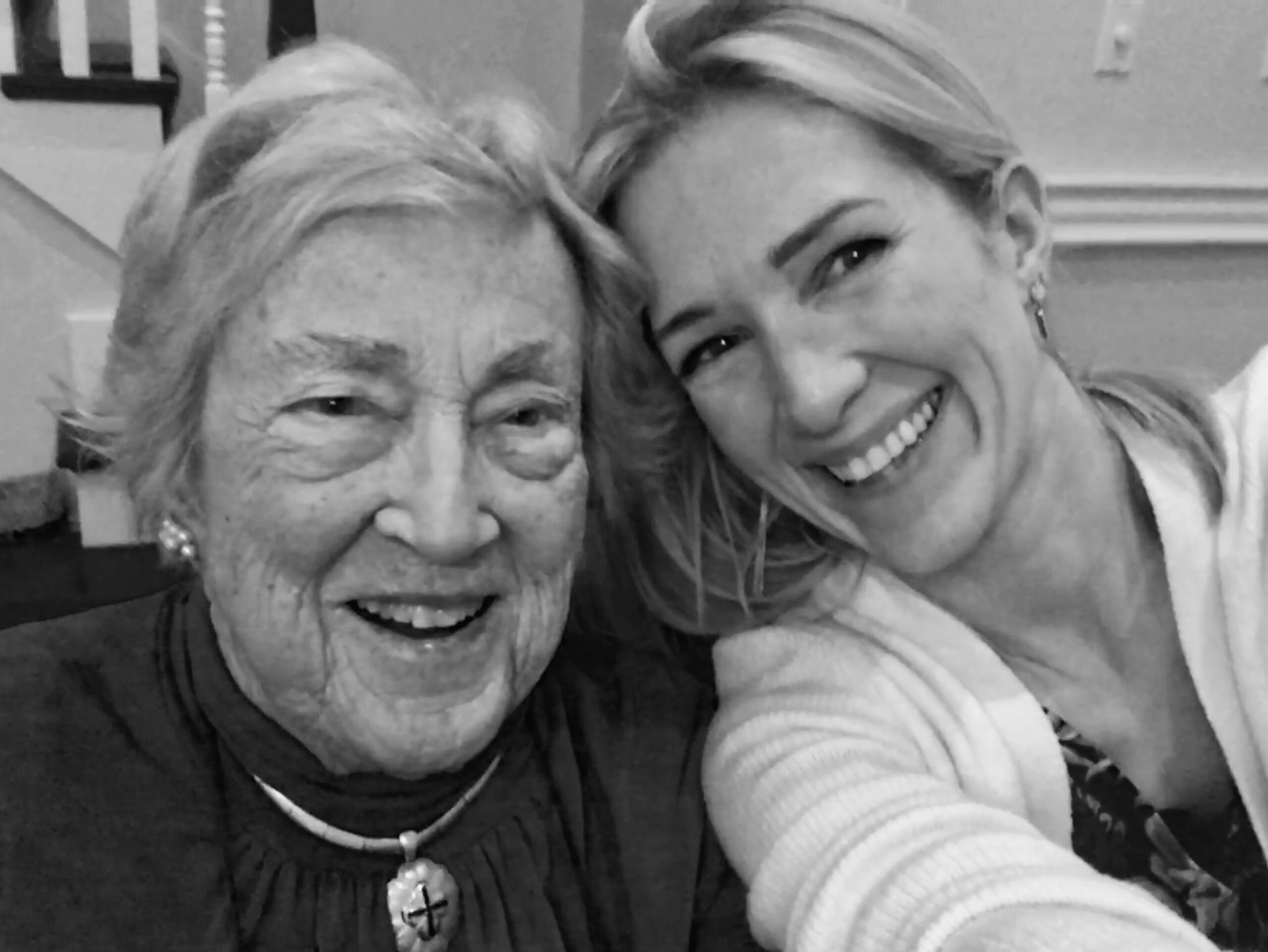
Note: The following TEDx talk was written and recorded in June 2020, three months into the COVID-19 pandemic. We are publishing the text in full here six years later, because many of these core messages about resilience still apply today. The photo here is of the author (our Founder, Dr. Caroline Adelman) and her grandmother, the inspiration for this talk.
Navigating in Darkness: Stories of Resilience
Imagine you’re driving down a road so familiar that you hardly have to pay attention as you drive. Without warning, traffic slows and then everyone is diverted onto a new road that is unfamiliar and unfinished, narrower and more treacherous than the roads you are used to navigating. There is no off-ramp, and you realize you have no idea where this new road leads. What do you do?
If there’s no turning back, you have to figure out how to move forward. So you slow down, grip the wheel, and continue driving…with no way to know yet if you can still get to where you hoped to go or what will happen if you run out of gas along the way.
There are many moments in life when the road we planned to travel is suddenly and unexpectedly unavailable to us. A natural disaster hits. A pandemic strikes. War or civil unrest breaks out. You lose someone you love, or lose your job… suffer feelings of grief, anxiety, anger or shame.
For human beings, some level of suffering is, unfortunately, inevitable. The question is not whether we will struggle, but when, in what ways, and most importantly, how we will respond. This knowledge is the shadow side of all we love and value. We discover that love can turn to grief or heartache, hope to disappointment, riches to rags, and life itself to death. So how best to live a life, in the words of Dostoevski, “worthy of [our] sufferings?”
Your responses to the unexpected turns of life depend very much on your internal narratives about what these moments mean about you, others and the world. In the field of psychology, we refer to these deeply held beliefs as cognitive schemas – essentially, the core beliefs that filter our interpretations of our various life experiences. For example, let’s say I hold a core belief that “others are fundamentally selfish and cannot be trusted.” If someone treats me with kindness, I may respond by thinking “they must want something from me,” rather than allowing myself to enjoy the kindness or accept it as evidence against my belief in the selfishness of people. On the other hand, if I believe at heart that “people always do the best they can with what they have,” I am likely to respond to others with grace and compassion, even under difficult circumstances.
In fact, the narratives out of which we live are so powerful that they may well be at the heart of our resilience as a species. Humans share with other animals the primitive instinct to fight, flee, or freeze in the face of perceived threat. It is what comes next that can set us apart. The cognitive ability of humans to create and share stories, to make meaning of our experiences, to act based on our values, goals and perceptions…this is what enables us to pivot, to work together, and to adapt to ever-changing circumstances. This is what allows us to see differently, so we can DO better, even in the face of age-old challenges. According to some historians, our unique strength as a species lies in our capacity for meaning-making and shared stories, and it is this cognitive advantage that put humans at the top of the food chain.
As we all face the reality of the current pandemic, the combination of uncertainty and potential danger is requiring us to adapt in ways many of us never imagined, and the ways in which we make meaning of our experiences will help to determine the longer-term consequences of this time in our lives.
So what stories are you telling yourself about this new reality? Are you living out of beliefs that lead you to feel helpless, or beliefs that build resilience and empower you to take personally meaningful actions in the face of these challenges?
Resilience, broadly defined, is the psychological ability to “bounce back” or recover in the face of stress and adversity. And because the study of resilience is rooted in understanding the behaviors and characteristics of people who have thrived in spite of obstacles of poverty, trauma and other adverse life experiences, we know that the raw ingredients of resilience are available to all of us, and don’t cost a thing.
As a psychologist working with individuals and communities hoping to develop greater resilience, I’ve invested a lot of time and energy exploring the question of what helps people to bounce back in the face of loss and adversity. And now, as a mother, mental health provider, and small business owner living through the relentless stress and uncertainty presented by this pandemic, I am learning just how intentional I have to be to make use of what I have learned along the way. When I am tired to my bones, and uncertain how best to move forward, I find myself thinking a lot about how those I admire most would respond.
This is ultimately why I am here today – to share with you some of the stories that have given me hope and perspective, and refilled my own well at the points that I have needed to dig deep to get through it all with my sense of self intact.
I recently heard an interview with Esther Perel in which she said “stories are the reservoirs of resilience passed from generation to generation” and this truth really resonated with me. So on this most recent Mother’s Day weekend, I spent hours talking with one of the most resilient people I have ever known – my grandmother — and found that her perspectives, after 96 years of resilient living, match up beautifully with the research and expert advice in my field.
This is my grandmother, Janet Williams. She is 96 years old, still full of love and life, and a true matriarch with plans to live past 100.
My grandmother, like many her age, has lived through a lot. She was 9 years old at the height of the Great Depression, 19 when she was forced to drop out of college for the war effort, 20 when her husband of 6 months was deployed to serve in WWII. The Atomic bomb landed on her 21st birthday, while her husband was deployed abroad. The night FDR died, he’d been due for dinner at her father’s home in Warm Springs, Georgia, and she sat with his security detail as they pondered what would come next for a highly uncertain world, still at war. She was 25 when her mother died tragically in a car accident and 6 months later, her sister-in-law, who was her closest friend, died of an embolism shortly after giving birth. Three of her four daughters have been widowed prematurely, and her beloved husband, my grandpa, died in 2014. Now my Grandmother finds herself suddenly living in a world in which a simple trip to the grocery store or a hug from a great-grandchild could prove life-threatening.
The road my grandmother has traveled has been filled with unexpected turns, some of them deeply painful. And yet, she is grateful and happy with the life she has lived. So how is this possible? How did her story of herself, of her life, become so dominated by the good stuff, even in the face of so much pain and loss?
Because the version of her life story she lives from includes so much more than just these stories of suffering. In fact, it sounds more like this:
She was raised by two loving parents, whose love, confidence and trust helped her to develop confidence in herself from a young age. Since she was a child, she has had a strong sense of faith and connection to something much larger than herself. Yes, she lost her mother at 25, but her mother had lost her own mother at the age of 5, so my grandma found herself deeply grateful for the gift of having had her mother in her life for 25 years. She has lived an extraordinary life filled with love, adventure, travel and good company, found great joy and meaning in raising her five children, and enjoyed a very happy marriage for 70 years.
If you ask my grandmother, she will also tell you that with each loss in her life, she gained deeper clarity about what mattered most to her, perspective on the preciousness of life itself, and a deeper sense of gratitude for what she had in her life. She will also tell you that loving relationships were a bedrock of hope and support, and a reminder of what mattered most during her darkest days.
And it turns out she is onto something. Good relationships impact everything from our happiness to our health to our cognitive functioning as we age. The investments we make in having strong, loving relationships will pay dividends for the rest of our lives, and help us to cope more effectively in the face of pain and setbacks. Strong relationships also help us to keep the big picture in mind, and often remind us that we are far more resilient than we give ourselves credit for being. In fact, good relationships are so powerful that the presence just one stable, loving adult in a child’s life is one of the strongest predictors of resilience for that child in the face of trauma. Just one. Think about that – you personally could be the difference between a longer-term negative outcomes and resilience for a child you love, just by showing up.
It makes perfect sense. Think of what a difference it makes on that unfamiliar road to have friendly company in the seat beside you.
When times get hard, we must turn our energy and attention to what we are living for, not just what we are living through. Prioritizing the things that sustain us, particularly our relationships, bolsters our strength and our courage to move forward in the face of uncertainty.
My grandma also believes a parent’s most important role is raising children who have a sense of value and purpose. She has taught all the members of her family, no matter the circumstances, remember who you are and act according to your values. In the absence of a road map, our values can serve as an internal compass, helping to clarify how forward movement will look, and ensuring we don’t lose track of ourselves as the path becomes uncertain. Some of the most powerful work I have done with clients has been based in this very idea – how to increase awareness of one’s most deeply held values, and then put one foot in front of the other in the service of these values, even when fear accompanies us for the journey.
Another lesson in resilience I learned from my grandmother is to hold your dreams close, and to look for and create beauty in the world in whatever way speaks to you. Forced to drop out of school when WWII started, my grandma never gave up on the dream of one day being a professional. Having devoted her adult life to raising her children, my grandmother took up painting in her 60’s for the first time and became a professional artist — showing her work in galleries within a few years of her first lessons. She is still painting, and still actively looking for the beauty all around her.
Once again, Psychological research confirms the importance of both this active stance towards one’s life, and the importance of this sort of mindful awareness of the good. The most resilient people have what is called an “internal locus of control” – essentially, a belief that they can impact their destinies by taking an active role, and the most powerful actions are those we take in service of our values.
Practicing looking for the good also trains our minds to include these details in the narratives of our lives, to remember the good with the bad.
And finally, it helps to recognize that even when we can’t control the circumstances, we have the power to respond with intention and to assign meaning to this new reality. Even in the face of grief and trauma, the ways in which we process and respond to these experiences have profound implications for our future wellbeing. The story we tell ourselves about our ability to navigate this sudden turn, and the actions we take in response to these beliefs, may be the difference between driving off the road and becoming better drivers. As a particularly resilient client of mine once said to me, “this is really hard… and I need to remember that I can do hard things.”
As we all face the current pandemic, adversity, pain, grief, and even trauma are inevitable for many of us. But these difficult experiences are not the whole story of this chapter of our shared history. There is also unimaginable kindness, generosity, beauty and courage happening in all corners of the planet right now. At this very moment, a nurse is holding a phone up to the ear of her dying patient, allowing family members the gift of closure. A teacher is dropping off dinner to a student whose parents lost their jobs. Communities across America are marching through the streets, risking their own health and safety to remind us that true peace requires justice for all. Parents all over the planet are digging deep to build forts, read books, snuggle scared children, and offer a bubble of security to their children amidst their own fears and grief. There are people being held up and held together by loved ones and strangers alike, all across the world… not just in spite of the vast challenges presented by this pandemic, but in direct response to them.
So how will you exercise your choice to continue “happening to your life” with intention under the current circumstances? What does showing up, guided by your values, look like in your personal corner of the world? And what stories can you draw upon for courage and strength as you face the road ahead? As I work to answer these questions in my own life, I am so grateful for my grandmother and the many other teachers like her, whose stories serve as our reservoirs of resilience and remind us that there is beauty to be found on the road ahead, uncertain as that road may be.
TEDx Video Link: https://embed.ted.com/talks/caroline_adelman_navigating_in_darkness_stories_of_resilience